The ground under Maitland
Maitland City Council describes its own landscape plainly: the floodplain is rich alluvial land, the alluvium gives way to heavier clay soils away from the river, and the upland areas are low rolling hills. That sentence covers most of the suburbs on this site. Central Maitland, Lorn, Tenambit, Morpeth’s lower streets, Bolwarra’s flats and Raymond Terrace at the junction of the Hunter and Williams rivers all sit on or beside river sediments. Rutherford, East Maitland, Gillieston Heights and Chisholm sit on the low hills, on clay of a different kind but clay all the same. Only the sandy country of Port Stephens, at Medowie and Nelson Bay, is a different story.
The council’s flood history explains how the sediment got there. Significant floods are recorded in 1820, 1893, 1913, 1930, 1949 and 1955, with 2007, 2015 and 2022 also causing significant flooding, and the February 1955 flood, the largest recorded in the Hunter Valley, reached 12.10 metres at Maitland. The levees and floodways of the Hunter Valley Flood Mitigation Scheme, built after 1955, are why the city is still here. They keep the river out. They do not change what the ground is made of.
What reactive clay does to a slab
Clay soils change volume with moisture. After a wet winter the clay under a driveway swells; through a dry summer it shrinks, and it does neither evenly. The edges of a slab, where rain runs off and the sun gets in, dry faster than the middle. Water from a downpipe or a leaking tap keeps one corner wet all year. A tree draws moisture from one side. The result is a slab that is supported in some places and hanging in others, and concrete, which is strong in compression and weak in tension, cracks where it hangs.
The engineers’ standard for residential slabs, AS 2870, classifies sites by how much the ground is expected to move, and the classes that describe most of the floodplain, M for moderately reactive through H1 and H2 for highly reactive, are the ones that call for the most care in the base and the steel. A driveway is not a dwelling under that standard, but the ground does not know the difference.
On the floodplain and about to pour? Send the suburb and the rough size and a local concreter will look at the ground, the falls and the crossing and quote in writing.
What the quote has to say
Four things keep a driveway flat on clay, and every one of them is invisible once the surface is finished. Ask for each in writing.
The base. Topsoil, roots and soft clay come out and the subgrade is trimmed to firm material. Where the ground is soft or the levels need building up, a granular base is placed and compacted in layers. On the estate lots of Thornton, Chisholm and Huntlee the builder’s fill under the driveway line is checked rather than trusted. The base is shaped to the finished falls so water never sits under the slab. Skipping this step is the single most common reason a young driveway fails, and it is the step a low quote leaves out.
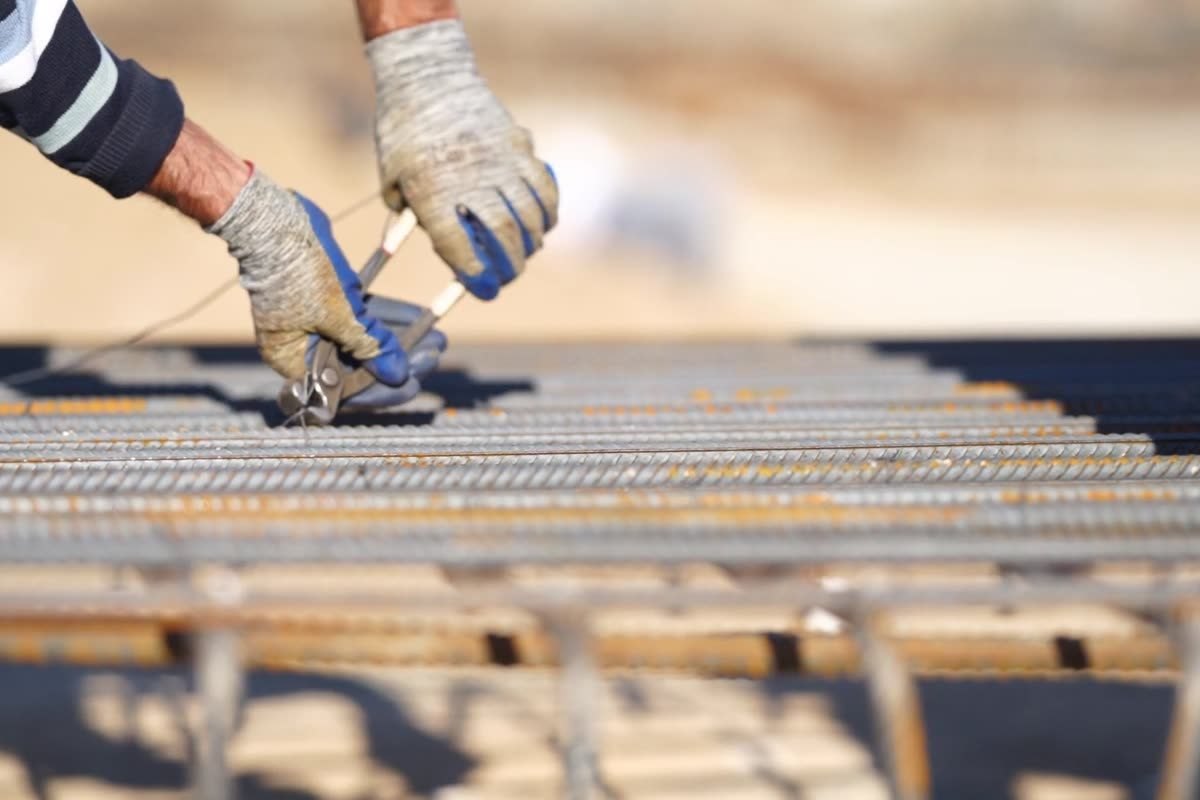
The steel. Reinforcing mesh belongs in the middle of the slab, held up on bar chairs at the right spacing so the concrete flows under it. Mesh laid on the ground and poured over sits at the bottom where it restrains nothing. SL72 is the common residential driveway mesh, with heavier mesh where a caravan, a boat or a truck will stand, extra bars at re-entrant corners and around pits, and dowels where the new slab meets an old one that must stay level.
The thickness. 100 mm is the usual residential driveway figure in 25 MPa or stronger concrete, thicker under heavy vehicles. Council crossings are heavier still: Maitland City Council’s drawing calls for 125 mm of 32 MPa concrete, and Cessnock City Council’s for 125 mm of N32 on 150 mm of base. Thickness is the number people compare, but it is the last of the four, not the first.
The joints. All concrete cracks. Joints decide where. Control joints are tooled or saw cut at close spacing, at changes of width and at the porch and garage lines, and cut early enough to work. Maitland’s footpath drawing asks for expansion joints with dowels at 8 metre intervals and tooled joints at 2 to 4 metres depending on width, which is a fair guide for a driveway too. Isolation joints keep the slab free of the house, the garage footings and the crossing, so each can move on its own. On clay this is the difference between a hairline crack along a cut line and a crack across the middle of the driveway.
Water is the other half
Clay moves because its moisture changes, so the driveway’s drainage is part of its structure. Falls are set from real levels at the measure so water runs to the street, a pit or a grated drain and not to the garage, the house or the slab edge. Downpipes discharge to the stormwater system, not beside the driveway. On the low side of a road, Maitland City Council’s driveway technical document asks for a grated trench drain at the low point, because gutter water can otherwise run down the driveway into the site. Gardens along a driveway edge keep one side wet and the other dry, which is exactly the uneven moisture that cracks slabs, so the edge detail matters.
Replacing a driveway that has already gone
If the driveway you have is the one that cracked, the ground has told you what it needs. Concrete poured over it copies the failure and raises every level. The old slab comes out, the base is corrected and the new pour goes in to the points above, which adds about $35 per m² for the removal. See removal and replacement. Where the crossing is part of the job, it needs council approval in all three council areas even like for like, and the Section 138 guide covers each council’s process.
Sources and the limits of this page
The soil and flood statements above come from Maitland City Council’s community resource kit and its flooding history page, the NSW water department’s description of the Hunter Valley Flood Mitigation Scheme, and NSW SES local flood information for Maitland and Cessnock, all read on 29 September 2026. AS 2870 is cited for its site classification terms only. No street or lot is classified here; the ground on your block is read at the site visit, and the written quote states the base, steel, thickness and joints for it. The full build is in the specification and the rates in the cost guide.