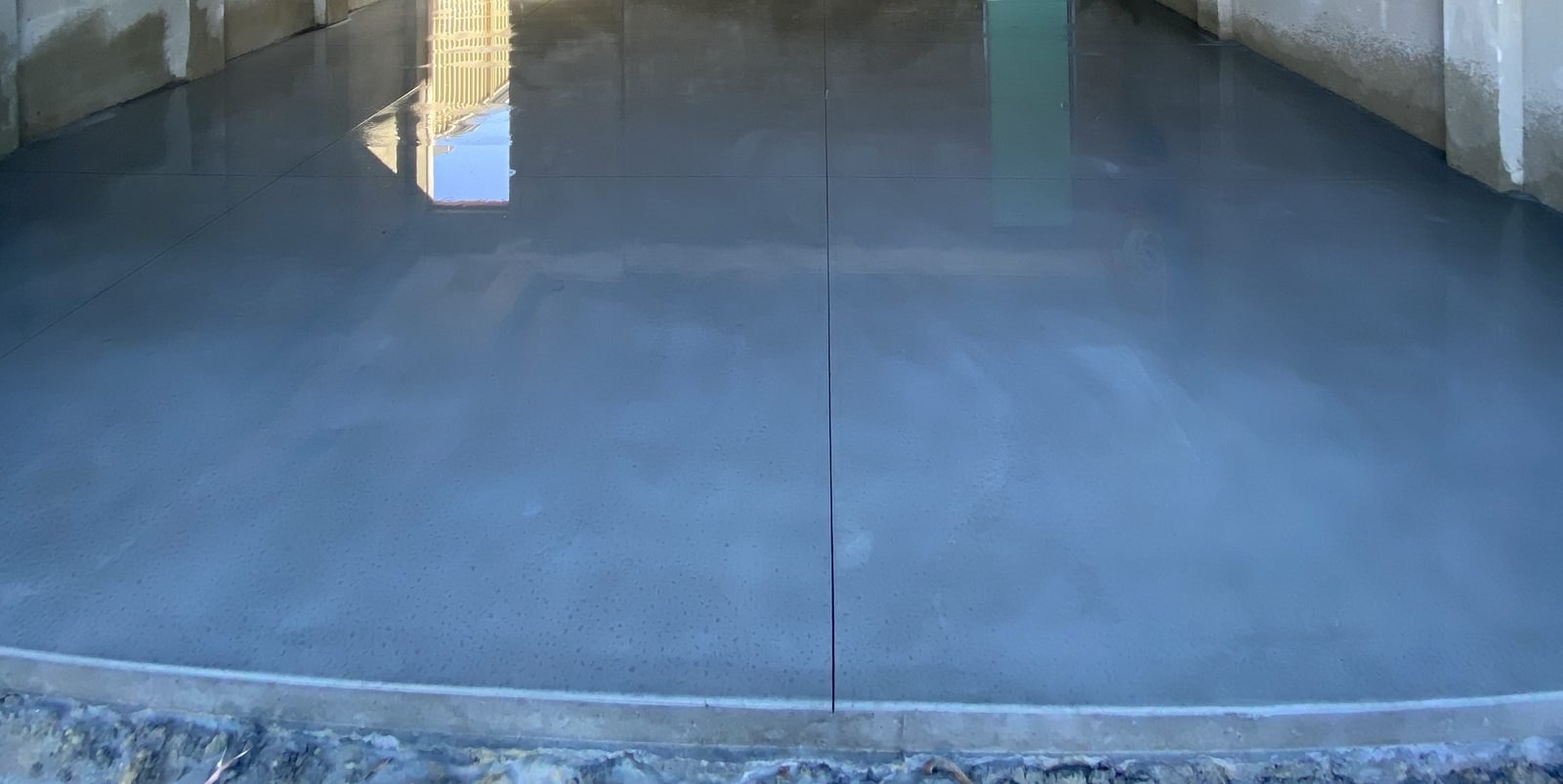
Drive any street in Rutherford, Kurri Kurri, Raymond Terrace or Medowie and count the sheds. The Hunter builds them for cars, boats, caravans, workshops and hay, and every one of them stands on a slab. This is the second strongest job on this site after driveways, and the one where a cheap quote goes wrong most quietly, because a shed slab poured thin, without edge beams or with the mesh on the dirt, looks perfect on handover day.
What the slab has to do
A shed slab carries the shed’s frame around its edge and whatever you park or stack in the middle. So the edge is thickened, usually to 300 mm or more, to take the columns and the hold-down bolts. A rebate is formed along the roller-door line so water drops outside rather than running in. Where a hoist, a caravan or a tractor will stand, the slab is thickened locally under the load. The mesh sits on chairs inside the concrete. All of this comes from the shed supplier’s engineering drawing, which is why the first thing a concreter asks for is that drawing.
Ground, again
On the floodplain suburbs the slab sits on reactive clay, so the pad is cut to firm ground, filled and compacted in layers where it needs building up, and the edges are dug into natural ground. On the sloping blocks of Bolwarra Heights, Gillieston Heights and Chisholm the pad is benched and the low side may need a retaining edge. On Medowie and Nelson Bay sand the base compacts well but the edges want confining. The specification covers each case.
Mine subsidence and shed approval
A large part of the Maitland and Cessnock council areas sits inside declared mine subsidence districts, among them Maitland West, East Maitland, Louth Park and Greta. For flat concrete this changes nothing: Subsidence Advisory NSW’s exempt development list includes driveways and hard stand spaces under all of its guidelines except 4 and 5. Sheds are different. Garden sheds up to 50 m² are exempt under every guideline and garages up to 50 m² under most, but bigger sheds and machinery sheds may need to meet the guideline that applies to the lot, and that can change the slab. Search the address on the NSW Planning Portal Spatial Viewer before you order the kit, and take the answer to the shed supplier and the concreter together.
What it costs
Guide rate $110 to $150 per m² supplied and laid, edge thickening, rebate and bolt setting included in the normal scope. Worked sizes with the moving parts are in the shed slab cost guide. A driveway or hard stand to the shed door, a path to the house and an apron in exposed aggregate can go in on the same pour. Where an old slab or a collapsed shed base has to come out first, removal adds about $35 per m². Slabs for dwellings and granny flats are a certified building process and are not referred through this site.
Run the size through the calculator, read the cost guide, check the Section 138 guide if the shed driveway reaches the street, then ask for a measure.
Rates on this site are guide figures for planning a budget. Your price is the written quote after the concreter has seen the block, and it can sit outside the guide where ground, access or a small area call for it.