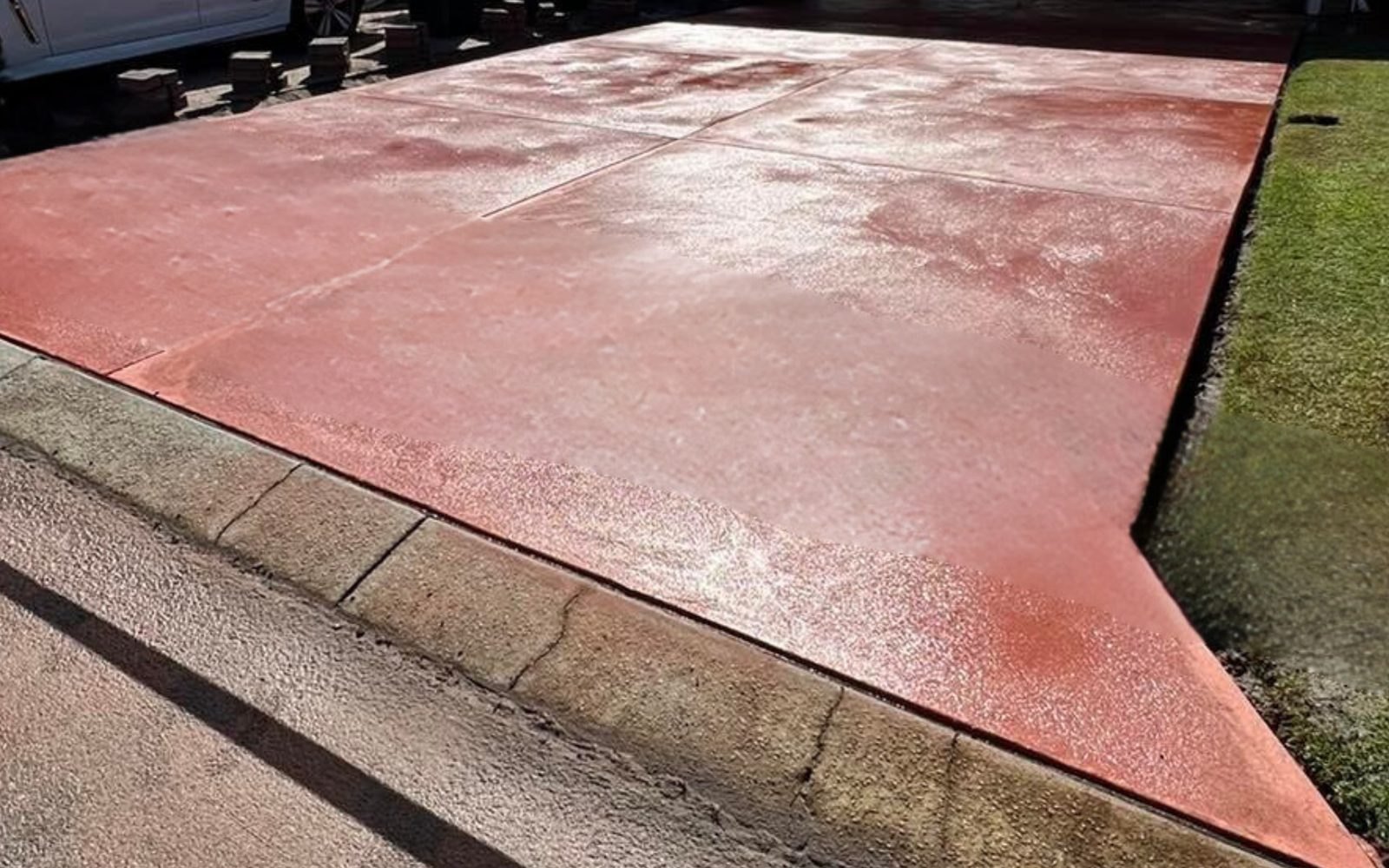
Concrete driveway cost per m² by finish
Three finishes cover nearly every driveway poured in the Hunter, and each has its own guide rate, supplied and laid.
| Finish | Guide rate per m² | What the extra buys |
|---|---|---|
| Plain broom finish | $95 to $130 | Grey concrete brushed for grip. The baseline. |
| Coloured concrete | $115 to $160 | Oxide through the whole load, so the colour runs the full depth. |
| Exposed aggregate | $130 to $185 | Stone washed back through the surface. Hides tyre marks, grips when wet. |
Supplied and laid means the lot on a normal site: trimming the ground, formwork, mesh on chairs, the concrete, placing, finishing and cutting the joints. It does not mean a pump where the truck cannot reach, a retaining edge on a steep block, or the council’s fee. Those come later in this post.
The finishes are described in full on the concrete driveways and exposed aggregate pages.
What a single, double or long driveway costs
The table at the top of this page multiplies the rates out for four common sizes. To place your own:
- A single driveway is about 3 metres wide. From a garage set 12 metres back from the kerb that is 36 m², or about $3,400 to $4,700 in plain concrete.
- A double driveway for a two car garage runs about 5 metres wide and 60 m², or $5,700 to $7,800 in plain and $7,800 to $11,100 in exposed aggregate.
- A double with a turning bay or a pad for the boat is nearer 85 m².
- A long drive on a rural block in Lochinvar, Greta or Medowie is where area runs away. Fifty metres at 3 metres wide is 150 m², which is $14,250 to $19,500 in plain concrete, and the reason long drives are nearly always plain.
Width at the street is capped by council, not by you. Maitland City Council allows a crossing of 3 metres for a single garage and up to 4.5 metres for a double. Cessnock City Council’s drawing allows 3 to 5.5 metres. Port Stephens Council caps a single at 3 metres and a double at 4. Inside the boundary the driveway can flare wider. For any other size, the calculator does the multiplication.
Rather have one figure than a range? Send the suburb and a rough size. A local concreter walks the block and quotes in writing, with the crossing and the council side spelt out.
What it costs to remove an old driveway
Breaking out the old slab, carting it to a recycler and correcting the ground underneath adds about $35 per m² to the new pour. On a 36 m² single driveway that is about $1,260. On a 60 m² double it is $2,100.
It is tempting to skip this and pour over the top. On the river clay under much of Maitland that copies the old failure into the new concrete and lifts every level at the garage and the kerb. The removal and replacement page explains what is usually found once the slab is up, and driveways on Hunter clay explains why the ground decides how long the new one lasts.
Council fees that sit on top of the quote
The strip between your boundary and the kerb belongs to council, and building, widening or replacing it needs approval under Section 138 of the Roads Act. Each council publishes its own fee for the 2026 to 2027 financial year.
| Council | Application | Published fee |
|---|---|---|
| Maitland City Council | Application for Vehicle Access Crossing (Driveway) | $435, plus $170 if a second pre-pour inspection is needed |
| Cessnock City Council | Section 138 application on the NSW Planning Portal | $244 processing, $62 assessment and $491.10 inspections, $797.10 in all |
| Port Stephens Council | Driveway Application Form | $320 per residential crossing |
These go to council, not to the concreter, and they are rarely inside a per m² rate. The Section 138 guide walks through each council’s process and what its inspector looks at.
The same fee schedules also show what each council charges when its own crews pour concrete. Maitland lists $560 per m² to restore a domestic concrete driveway. Cessnock lists $594 per m² for 125 mm plain concrete where council builds a crossing for an owner, and $5,052 for a 3.6 metre layback. Port Stephens lists $225 per m² for restoring a domestic driveway, with a minimum of $1,109.90. Those are charges for small areas of council work, not a market rate for a whole driveway. They do make one point clearly: the crossing is the dearest concrete on the job per metre. Maitland’s drawing asks for 125 mm of 32 MPa concrete there, and Cessnock’s for 125 mm of N32 on 150 mm of base, and both councils inspect it before the pour.
A worked example from quote to kerb
Take a house in Thornton with the builder’s single strip, about 30 m², and an owner who wants a 60 m² double driveway in exposed aggregate.
| Item | Sum | Guide figure |
|---|---|---|
| New 60 m² driveway, exposed aggregate | 60 m² at $130 to $185 | $7,800 to $11,100 |
| Remove the old 30 m² strip | 30 m² at about $35 | $1,050 |
| Maitland City Council application | published fee | $435 |
| All up | about $9,300 to $12,600 |
The same driveway in plain broom finish comes to about $7,200 to $9,300, a saving of roughly $2,100 to $3,300. Not in either figure: a pump if the truck cannot reach, a grated drain if the driveway falls towards the garage, or a street tree or stormwater pit in the way of the crossing.
What pushes a driveway quote up or down
- The ground. Floodplain clay and builder’s fill need a base cut to firm material and compacted. Medowie and Nelson Bay sand needs its edges held in. More preparation is more money, and it is the last place to save.
- Access. A truck that can chute straight into the formwork is the cheap case. A pump or a barrow run is a line on the quote.
- Slope. A block that falls away needs benching, a thickened low edge or a small retaining edge.
- Finish and stone. Plain to coloured to exposed, and within exposed the stone decides the top of the range.
- Size. A small pour carries the same truck, crew and day as a large one, so its rate sits higher. Pouring a path, a patio or a shed slab the same day brings every rate down.
- What parks on it. A caravan, a boat or a truck wants a thicker slab with heavier mesh.
- What is in the way at the kerb. Maitland keeps a crossing 2 metres from a street tree and 600 mm from a stormwater pit, and its schedule lists $800 for street tree planting connected with a driveway.
Is my quote fair? Five checks
A question that turns up on renovation forums again and again runs like this: $16,000 for a driveway 16 metres by 6, is that fair? The honest answer is that it depends what the $16,000 buys, and five checks sort it out.
- Divide by the area. 16 by 6 is 96 m², so $16,000 is about $167 per m². That sits inside the guide range for exposed aggregate and above it for plain concrete.
- Match the finish. The same sum is a fair price for one finish and a dear one for another.
- Read what is written down. Thickness, mesh, concrete strength, base preparation and joint spacing should all be on the quote. If they are not, ask. The specification lists what each should say.
- Look for the three extras. Removal of the old slab, the crossing at the kerb and the council fee are either in the figure or they are coming later.
- Check the paperwork. The NSW Government’s guidance for homeowners is that a written contract is mandatory for work over $5,000, that the most a contractor can ask as a deposit is 10 percent, and that Home Building Compensation cover is required on jobs over $20,000 before any work starts or any money changes hands. It also says to look up the licence on Verify NSW first.
Two quotes a third apart are usually describing two different slabs. The cheaper one is nearly always thinner, or sitting on ground nobody prepared.
Ways to bring the price down without a thinner slab
- Pour jobs together. One truck, one crew, one day, shared across the driveway, the side path and the shed slab.
- Put the decorative finish where it is seen. Exposed aggregate from the garage door to the boundary, plain broom finish down the side and on the long run.
- Sort the access first. A gate widened or a fence panel lifted out before the pour can save the cost of a pump.
- Keep the crossing simple. A crossing set square to the kerb at the width council allows, clear of the tree and the pit, avoids the site-specific design that Maitland says takes 28 working days and is done at the applicant’s cost.
How these figures were put together
The per m² ranges are this site’s published guide rates for the Maitland, Cessnock and Port Stephens council areas. They are budgeting figures, the same ones used on every service page and in the calculator, and they are not quotes. Maitland Concrete Works is a referral service, so the figure that counts is the written quote from the independent concreter who visits the block.
Every council figure in this post was read from that council’s own page or fee schedule on 29 September 2026, and the links are below. The contract, deposit and cover rules were read from the NSW Government’s guidance for homeowners on 16 November 2026. Councils reset their fees each July, so check the current schedule before relying on a number here.
Sources
- Maitland City Council, driveways (application fee and processing time)
- Maitland City Council, Fees and Charges 2026 to 2027
- Cessnock City Council, driveways
- Cessnock City Council, fees and charges
- Port Stephens Council, driveway construction
- Port Stephens Council, fees and charges portal
- NSW Government, choosing the right tradesperson or builder (contracts, deposits, cover)
Council figures were read on 29 September 2026. Councils reset fees each July and can change drawings at any time, so confirm a figure with the council before relying on it.